Wednesday, 14 February 2024

Goodbye Whadjuk Boodja

 Well, I wasn't expecting that. 

As SQ214 pushed back and taxied to the runway, a dissociative episode hit me like a ton of bricks. What is dissociation? I've been asking myself that for years, and I think I understand now. It is a rection to anything which causes a trauma response. We all know about the fight/flight trauma response, but there are more than just the two. There is 'fright' which causes the respondee to 'freeze'...you know the rabbit in the headlights that is so terrified it can't move? Dissociation is being so afraid that the flooding of cortisol in the brain causes the pre-frontal cortex to disengage; as a result we can't function...and become bunny pancake by the oncoming car. 

What was it that terrified me into a freeze trauma response? It wasn't aviophobia. Thanks to the years of Dialectic Behaviour Therapy, 'Step Four's, journalling and obediance to the advice carved into the wall of the UWA arts faculty, 'know thyself', I'd say it was the fear of not knowing who I was now. Identity crises are not for the faint hearted, we all know that, we all experience them. I had spent twenty years 'working on my health'. A few years ago I started to receive some effective help from the government, it was called disability support. So, I identified as a disabled person. I had thought that my life was over. I still identify as a person with an invisible, psychosocial episodic disability, but now I can see that a disability doesn't need to be the end of our quality of life. Discovering my talent for musicology and having opportunities land in my lap has forced me to understand and meet the new way of being me. It's unsettling, but nothing a good cry can help to flush out. 

Then we took off, the view was spectacular and the crying started all over again. The landscape of the land I was born on is breath taking and I feel 'connection to country' very much. It would be easier to leave if it were the toxic late stage capitalist areseholery which was on show rather than beautiful Whadjuk Boodja. 

And here's a picture. 


Auf wiedersehen!


Sunday, 11 February 2024

From the Compression Chamber

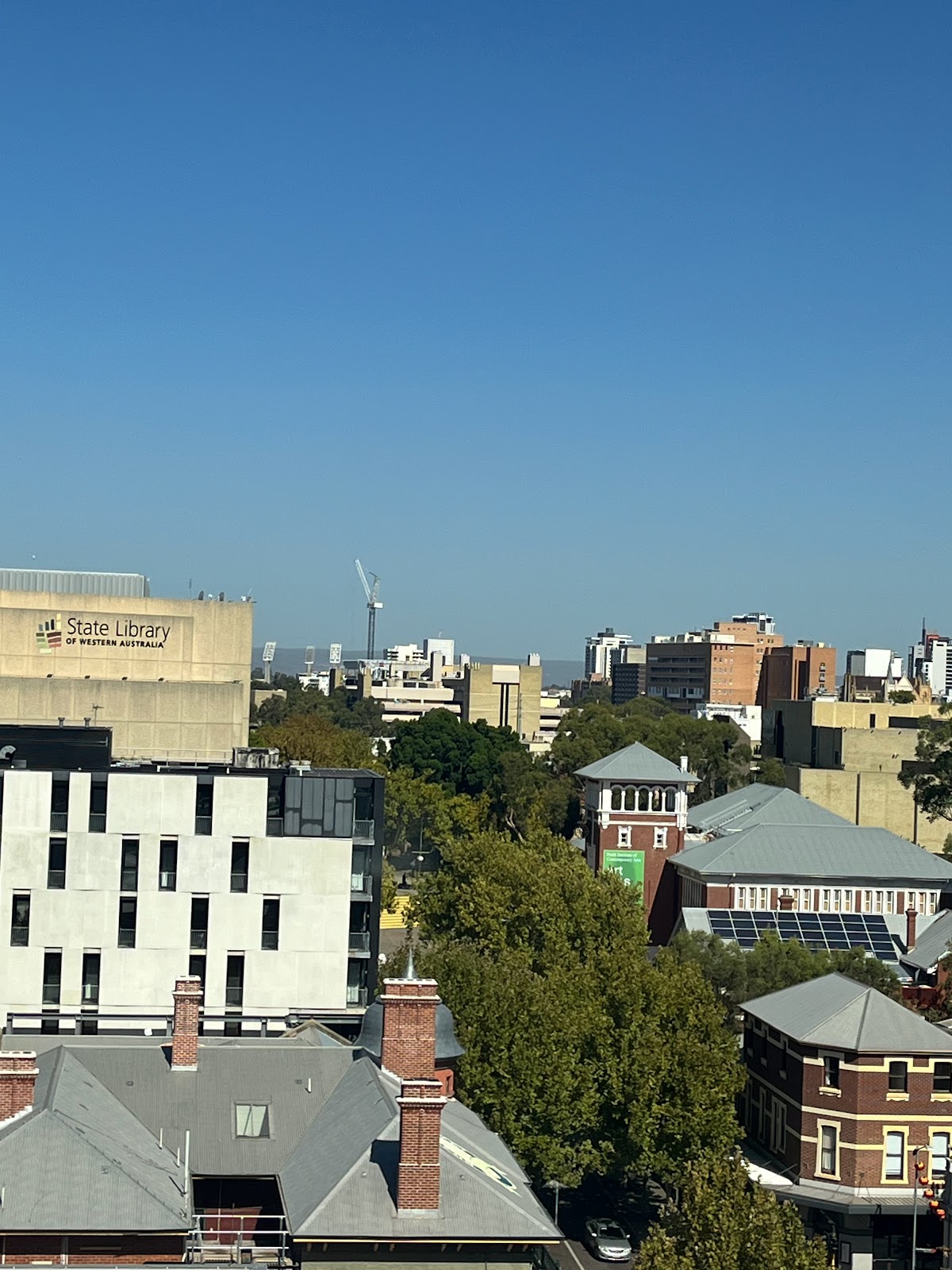
The view from my hotel on James Street.


Thirty years ago almost to the week, I prepared and left for Europe with my mate Nick. It was so much easier then. Preparing for my move to Dresden over the past nine weeks has been exciting and challenging. During the final 24 hours before departure, I feel on the precipice of My Life Part 2

The cahos within my hot apartment drove me to a hotel in Northbridge. This airconditioned sancutry is my depcompression chamber where I reflect on the past years and prepare for my upcoming year in Germany. Twenty years ago I returned to Australia to get help for the debilitating mental health symptoms which were ailing me. In those two decades I tried different jobs (bus driver, English teacher, peer support worker), got sober and engaged in much therapy and many treatments. Now I feel good. I identify as having an invisible and episodic psycho-social disability as a result of being neurodivergent and having complex PTSD. I continue to have melt-downs, but I recover quickly. I know what sets me off, so I can avoid that. I am ok now. Ahead of me lies a year of historic musicological research at the State Library of Saxony. I think it will be very fulfilling and satisfying. I am thrilled to be back in Germany. 

Thursday, 27 February 2020

A Portrait: The Borderline Warrior

Here is my experience of my participation. 

I believe my purpose in life is to support those suffering Borderline Personality Disorder. I have faced challenges in my life I wish no other will. I believe that with a little understanding, education and compassion, this is easily achieved. Together with Steve Wise and Gabrielle Brand, a photographer and a researcher, I was given the opportunity to help. 

I shared my life story generously and bravely, inspired by potentially reducing the suffering of others with my condition. After nearly two years of prodding, laughing, crying, reflecting and connecting, a photographic portrait and educational resource was born. 

Little did I know, this process was healing and an important part of my recovery. I was heard, my tears and laughter were shared. I was treated as an important and valuable commodity. The photographer and researcher were such beautiful, intelligent and fun people, it was a great self esteem boost to be treated as their equal.  The cherry on the cake, was the first time I set eyes on the portrait. 

Is this how I am seen? The woman in this portrait is proud, elegant and strong. She's competent, she's powerful, she's like an amazonian warrior. For a patient with 'a poor understanding of self', or 'identity disturbance', this was a welcome sight. From today on, I understand myself to have all those qualities. As a result, I feel humble, I'm no better or worse than others, just like all others I have strengths and shortcomings. I can walk in the street feeling entitled to be there, I can breathe my fair share of oxygen, I no longer need to feel guilt for taking oxygen which I formerly believed should've been for others more worthy than myself. All of us are worthy and equally deserving. 

I'm excited to see that this project, not yet fully launched, is already making a difference. Gabrielle Brand and Steve Wise, I can't thank you enough. 


This photo shows how music helps me to fight my mental illness and addiction.


In the portrait, you can see a number of images or symbols, which represent important aspects of my recovery.

My instruments are my weapons, music connects me to something spiritual and to other people. in an orchestra, I feel I belong, that I am a part of a musical family.
My ‘Big Book’ from my 12-step program and my beloved Mont Blanc fountain pen are held in my left hand. Attending meetings and belonging to fellowships for alcoholism and compulsive overeating has fast tracked my recovery since 2011. I write a journal, and this helps me to notice, validate and accept my emotions and thoughts. My fountain pen is such a delight to write with and reminds me fondly of when it was gifted to me in Luzern in 1999.
A tally of five followed by a full stop denotes how often I made attempts on my life. The punctuation represents the commitment I made to the universe that I will never ever try again to end my life.
A nine-pointed star hangs around my neck. This is the symbol of the Baha’i faith, a religion which gives me inspiration. 
My eyes have been masked because a part of Borderline Personality Disorder is identity disturbance. The self-hatred I grew up with taught me to act like someone I thought would be accepted and loved. This naïve strategy backfired as it led to me not knowing who I was. It was originally Steve Wise’s idea, his job as photographer was to get to know me, so that my portrait was more than a picture, that it told a story of who I was. After three interviews, he saw me as a warrior. This shocked and delighted me, as I was so busy fighting, I had never realised how successful a warrior I indeed was.
Mahler’s handwritten score of his ninth symphony morphing into pagers from my journals, provide the backdrop to my portrait. Whilst hospitalised in ward 2K at Royal Perth Hospital after an overdose, WASO were performing Mahler’s Ninth Symphony. It is lucky that through the back alleys the Perth Concert Hall and ward 2K are only a few hundred meters from each other. I snuck out of the ward that night and sat in the back of the stalls to listen to the performance in my hospital pyjamas. I reflected on Mahler’s superstition around ninth symphonies in which he believed this was his end approaching. He was frightened and didn’t want to die. And there was I frightened to live. It was that moment that I made a promise to myself and to a power greater than me that I would like Gustav, learn to love life. I would go to any length to find a life worth living. I’m proud to say, that with music as my medicine, I now love my life and I am overwhelmed with gratitude for all.

PS, I wasn't wearing my pyjamas, I wish I had been cause it's such a good addition to the story. 

Saturday, 22 June 2019

Back to the bassoon.

A year ago, I came across another incredible student. A baroque bassoon student. He inspired me to play again. I needed belief that this project was possible, to find an instrument for sale and $8000 to buy it. This is how it happened.

A very supportive colleague in Italy encouraged me with passion and fed me every step of this journey. I asked all my European colleagues to keep an eye on the market and inform me should an instrument become available, which it soon did. The next step was to raise some capital. So I set up a crowd fund page and I published it. Here is the text which accompanied it. 

I love playing the baroque bassoon. Ever since I was a young girl I dreamt of being a professional musician. I was so driven that I worked hard with all my heart. By the age of 30 I had succeeded and was working as a freelance musician in Australia and Europe. 

When I was still very new in my career as a baroque and classical bassoonist in Amsterdam, it became very apparent to me that the psychological struggles I had experienced all my life were getting worse not better. After much scrutiny from a team of mental health workers in The Netherlands I was diagnosed with Borderline Personality Disorder (BPD). This condition causes emotional disregulation, depression, anxiety, difficulty with personal relationships and a tendency to self harm or sabotage. The doctors informed me that this condition could not be treated. 

I was completely overwhelmed and didn’t know what to do. On impulse I returned to Australia, sold my instruments and began working as a bus driver. This was because at the time I was angry with myself, I felt it was the punishment I deserved. This was self sabotage typical of those suffering BPD. Without my primary love, which is music, my condition became much worse. My bus driving career ended after a road traffic accident and I retrained as an English Language Teacher. Things were hard and in the absence of support or treatment, I found an escape in alcohol. 

Thinking an altruistic job would feed me some self-esteem, I started work teaching asylum seekers in immigration detention on Christmas Island. This was short lived as I was sent off the Island suffering with Post Traumatic Stress. The company I worked for took good care of me financially due to the workplace injury, however in another act of self sabotage, I quit my job believing I didn’t deserve to be paid if I were not working. 

Things still needed to get much worse for me before I arrived at my life epiphany. I was taken to Royal Perth Hospital by the police in an ambulance after making yet another attempt on my life. The months in the psychiatric hospital were exactly what I needed, yet a very dark time in my life. I will never forget the day during this hospitalisation, when I heard my self think, ‘suiciding isn’t working for me, from now on, I have no choice but to embrace life’. I recall a conversation I had with my 'higher self'. I asked why was suicide not working for me. What I 'heard' was, you can't go yet, you have a purpose here. You cannot decide when to leave, that will be decided for you. Your task is to share your story, be brave, be generous. Sharing your story will break stigma about mental illness and addiction, it will provide validation, love and support to those still suffering, it will reduce their suffering. I’d worked hard in my life, but my greatest achievement has been to learn to love life and to love, accept and forgive myself.

Eighteen years since diagnosis, my condition is much improved. I have many years of continued sobriety thanks to a twelve-step program and I have recently completed three years of intensive Dialectic Behaviour Therapy. This therapy is based on mindfulness and has rewired my brain thanks to the phenomenon of neuroplasticity. 

 I have been teaching and performing baroque bassoon at the University of Western Australia since the beginning of this year. And I am grateful to have my bassoon career again after many years of illness. My crowd fund campaign, if successful will enable me to purchase an instrument of my own. Baroque bassoons rarely come on the market and I have recently been offered and instrument through a dealer in Amsterdam. I will be forever grateful to those who can support or share my campaign. I’d like to take this opportunity to publicly thank the doctors and friends who assisted in my recovery, it’s been a long bumpy and spiritually enlightening road. I also wish to be there to support anyone recovering from alcoholism or any mental health struggles not just Borderline Personality Disorder. I am available in person in Perth, Australia, by email or Skype for anyone wanting information or support for anyone interested in or affected by my story.

In twelve days the funds required had been raised and friends were travelling around The Netherlands from Switzerland in order to assure the instrument was sound and in good working order. On the fourth of July 2018, the postman delivered it to my front door. It was absolutely beautiful.

This was quite a confronting journey of acceptance. Acceptance of love and worth. The funds had been donated by sixty-five people in Australia, Asia, Europe and North America. People who believed in me, people who loved me: Loved me and believed in me more than I did myself. It was a battle to accept, and much was learnt from doing so. I found that reading all those lovely comments was so strengthening and heart warming. I felt committed to all those people to play the most beautiful music and to volunteer generously in the music community. I’ve made a pact with myself to never let my ego or insecurities get in the way of the music. Music is love, music is recovery, music is a power greater than myself. 

Wednesday, 31 May 2017

This is what recovery feels like.


On Monday I had the most amazing day.  I looked at everyone with kindness and love. If someone had something I’d have felt envious about in the past, I looked at it thinking, wow that’s cool, I’m going to work towards having that one day. I didn’t feel any resentment towards anything/anyone and most amazingly, if someone said something sensitive or cutting, it didn’t hurt me.

Furthermore, I felt so confident that I was able be a 'part of’, I belonged. At orchestra rehearsal in the evening, I joined in on conversations in the break, I was comfortable to just listen, I didn’t feel like I had to be impressive or please anyone in order for them to accept or approve of me, I knew I was enough and worthy. 

This feeling was surprisingly odd, I’d never felt like this in my life, it was so new. I sort of walked around bedazzled (yes that is a word) because nothing was frightening me. I was curious at to why the boogey man hadn’t jumped out at me, but I quickly understood that he didn’t need to, nor was he going to. I understood for the first time ever why people wanted to live, why they were afraid of dying. 

Since Monday, I have become used to this feeling very quickly. It’s like a drug, if you have something that makes you feel so good, you want it again and again, one possesses a new level of expectations. I have felt good every day since Monday. It’s feeling normal now. Four consecutive days of feeling 'normal'. Just two days ago I was explaining to my therapist, how I was feeling the most remarkable sense of ecstatic joy. She explained to me that I was not feeling ecstasy, rather how people without emotional disregulation experience healthy happiness. 

It is remarkable how people react to me. They smile and look at me with kindness and love. They are happy to be in my presence. It is very subtle, but for me it is so loud and clear. I am a pleasure to be around. I had dinner Tuesday and Wednesday with people. Friends invited me to eat with their partners and children. It felt like I was a part of a family. Just being me was a contribution.

I am so filled with gratitude and humility. I feel like God has said, ‘Kate, welcome to the human race, you are one of them.

The combination of a Twelve Step Program and Dialectal Behaviour Therapy together with my sheer determination and courage have made this all possible. For this I am truly grateful.

Mountains of love to my DBT therapist and AA. Thank you for accompanying me on this journey of recovery.


Tuesday, 5 July 2016

You have to be happy to discover you are depressed.


Years of preparation and dreams were invested in winning a place in the class of a renowned baroque bassoon professor in The Netherlands. I had arrived. I was so happy. Everything could not have been better. So, I guess at this stage I had nothing to explain the frightening anxiety, stress and depression I was suffering. Previously, I had many environmental explanations for being unhappy. With those factors whittled away, the mental ill health lay as exposed as a reef at low tide.

For years, I had understood I was ‘being silly’, ‘overreacting’, ‘attention seeking’, 'showing off'. Since the age of one I was known to react outrageously. As a toddler I would smash drinking glasses with my teeth or storm around on all fours imitating a Sherman tank. At primary school I was the ring leader of the playtime games one day and hiding in the library the next suffering social anxiety. I so longed to be someone else. I longed to be a boy.

From the age of eighteen I escaped this pain with alcohol and drugs. So many fun nights were fuelled on self-medication. Breaking into the Sydney Botanic Gardens to play with the nocturnal animals and hug the life sized muscly statues. Jumping the fences of the Municipal Swimming pools in Paris for midnight skinny dips. All night partying in roof top spas in Reykavik's midnight sun. Not to forget the aforementioned Bicycle Thieves of a debauched Amsterdam night. I also tried escaping geographically. Out to dinner one night on Oxford St Darlinghurt, living in London three weeks later. My friend likes to hold himself responsible for this fast relocation with guilt, but I know deep down he is proud to have made such an awesome suggestion. A former Viennese resident, he exclaimed his excitement at how easy it would be for me living in Europe now that my newly issued British passport had arrived. I was gone!

Well, 'gone' didn't go quite as fast as a I had intended. I heard from Nick, 'Come on Kate, there's a cheap flight leaving in two days, come with me.' Well despite sleeping at Sydney airport to assure a front spot in the queue, we didn't get on the flight. Nor did I the following week, the third week I did. Three weeks of farewell parties at our famed Stanley St abode made a festive exit.

I've diverged from the depression. So, furnished with a valid medical complaint I felt justified in seeking medical assistance. My symptoms were taken very seriously. I was happily surprised not to be fobbed off as being ‘being silly’, ‘overreacting’, ‘attention seeking’ or 'showing off'. I was assigned a team of three mental health clinicians who observed me weekly over a period of six months. During this six month period I was forbidden to drink alcohol, smoke cannabis or avoid exercise; I was to run (not walk, run can you believe it?) for a half hour period every second day. 

Being taken seriously had a profound effect on me. Amazingly I had absolutely no difficulty abiding to these terms. I thought it was the cure and that that was all I had to do to be freed of my terrifying mental distress. I reported weekly like a diligent parolee. In place of drugs and alcohol, I took up tea and biscuits. I purchased myself a china teapot, a selection of loose leaf teas and bone china cups. I invented my own form of tea ceremony. With the motivation of being cured, I was finding the task not a challenge at all. Those who knew me well were astonished at my abstinence and diligence.

With the six month period elapsed, I felt cheated. I had played my part of the bargain, why was that black dog still hanging around like he'd just rolled in excreta? It was because, drum roll, I had a condition called Borderline Personality Disorder. Personality disorder????? 'Excuse me?', I thought, 'well you have a dress sense disorder!', I wanted to say to the doctor. There was no medication for this condition and it could not be cured, but with psychotherapy the symptoms could be eased. 

Funnily, except for the bad name, I was sort of happy to have a diagnosis. There was a reason I was in so much pain, a reason why it felt like no one liked me, a reason I hadn't been successful, a reason I wanted to kill myself. This of course meant I wasn't being silly’, ‘overreacting’ or ‘attention seeking’. What a fantastic relief. I wanted to tell everyone, 'hey I'm not useless, I'm ill!' It was terrific validation.

Why was it Borderline Personality Disorder? Borderline of what? I did my research as one does, and 'we' lived on the borderline of psychosis and neurosis. Well, that made a lot of sense to me, in fact it was a very good description of how I felt. Disorder with your personality? So I understood that to mean I was born (could've been some nurture in there too, wasn't sure) with a personality that doesn't work in your favour. This also make buckets of sense, as when I was in distress I would instinctively want to do something totally destructive, like put your hand in a blender and turn it on, cut all your hair off, break your good reeds before and audition. There were occasions I couldn't stop myself sabotaging or hurting myself. I'd watch myself doing it, unable to arrest the movements of my body whilst observing incredulously.

And so began the psychotherapy. I was already 31 years old and the healing had only just begun.

Monday, 20 June 2016

Spiegel im Spiegel

Wednesday is the final group therapy meeting of my Dialectic Behavioural Therapy (DBT). It has been a 52 week course of intensive introspection and skill building. Others may arrive bearing wrapped gifts or cupcakes, I want to bring something much more reflective of my experience.

It is by chance that just a few days ago I heard a radio performance of Spiegel im Spiegel by Arvo Pärt. On this very first hearing I was taken aback by how similar this piece made me feel to how I felt whilst practising DBT mindfulness skills. It was immediately clear that I should perform this piece for my therapists and fellow group therapy members.

Spiegel im Spiegel is so named because of the infinite repetitions occurring when one places a mirror in a mirror, or Spiegel im Spiegel. These repetitions can be heard in the arpeggios performed by the piano over which the cello line plays repeated F major scales, the scales create long beautiful soothing melodies. Naturally, these melodies are essentially scales in contrary motion, a musical term meaning ‘mirrored’. As the piece continues they lengthen and lengthen. I understand this to symbolise the ever increasing images of the mirrors’ reflections. Pärt has cleverly created tension and release by choosing to commence or end the scales on notes other than the traditional tonic or 'do'. The cello melody commences on the supertonic ('re'), the second note of the scale,  this gives me the impression that the piece had started before the musicians had even arrived. Perhaps the composer wants to remind us that we exist in a tiny moment within an infinity?

This is precisely what I have done for the last twelve months. I have looked at myself in the mirror, again and again. I have become aware, through repetitive mindfulness activities, of every thought, physical sensation, emotion or urge. When the reflection within the reflection is examined and understood, the cause behind these thoughts, physical sensations, emotions and urges becomes clear, it's cathartic. With complete acceptance and/or willingness to change, I have been able to calm and validate myself. I have been able to see how normal it has been of me to do what I did in those challenging circumstances. Alas, my experience has been of much repetition. In these reflections I found beautiful soothing. One of the distress tolerance skills is to self soothe through the five senses. I use my ears to be soothed by music, my eyes to see the beautiful patterns the music makes on the page, I can smell the old aged wood of my cello and the rosin or tree sap on my bow. I feel the wood on my skin as the instrument vibrates with the resonance of sound. The dissonance and harmony comprise two opposing forces which can be simultaneously true, this is the dialectic. It's what suffering Borderline Personality Disorder is. It's wanting to live and die in the same moment; it's hating something because you love it so much; it's many strange things which I have learnt to radically accept.

F major is a beautiful choice of key. Before the common practise of equally tempering tuning in the late eighteenth century, key signatures would arouse desired emotions in the souls of audiences. So for the lessor musical scholars in my audience, what I am saying is that the note a composer chooses as his 'home' note can affect the emotion one feels in the music; depending of course how the musician chooses to tune his instrument. Temperament (are you seeing the emotional connection?) is a frightfully complicated mathematical phenomenon. Go and chat to Pythagorus, he can explain it so much better than I. F major is a key which evokes a pastoral setting, it places me in a forrest or upon a rolling hill. Mother nature is my God, it is the glory of natural instinct which tells a flower when to bloom or an animal to migrate. This for me is evidence enough of God's existence. My earlier religious experiences taught me to despise the word 'God', so mother nature she is for me. I guess this is all a long winded way to explain how F major places me in the midst of my higher power, in her greatest cathedral.

Learning to play Spiegel im Spiegel has required much skill in emotional regulation, the third of the quartet of skill groups one learns in DBT. Yet another dialectic, to remain detached from the emotion of the music in which I wish to swim. Maintenance of my rational brain, is a requisite of expert cello execution. In DBT language 'wise mind' is a place where the perfect balance of emotion and rational mind exist. This is where I must remain to affect the emotions of the listeners, yet maintain a high level of technical prowess.

I greatly hope this performance of Spiegel im Spiegel will bring great comfort, encourage further soul searching and celebrate the end of a truly remarkable year of therapy. Thank you Marsha Linehan, creator of Dialectical Behaviour Therapy.


Thursday, 9 June 2016

My names's Kate but I can't say the next bit.

Do you have any idea how hard it is to discover you are an alcoholic? It's hard.
Do you have any idea how hard it is to say, "I'm an alcoholic"? Even harder.

It transpires that saying it is actually the easy part, believing it takes months.
Everyone else was doing it but I couldn't do it. So at my first meeting that's what I said, "My name's Kate, but I can't say the next bit". No one judged, they just listened. What a beautiful group of people.

I only went to AA meetings to prove that I wasn't an alcoholic. But after ninety meetings in as many days, I learnt that alcoholism is a disease of denial and I was indeed an alcoholic.

I'm grateful to my friend who first suggested I go. She was very clever and discreet in her method. I had admitted myself to Christmas Island Hospital because I was so afraid of committing suicide, I felt safe at the hospital. She came to visit me and brought me some reading material. The book had a blank cover, very odd. When I opened it I saw it was a book from Alcoholics Anonymous. I was furious. I didn't want to divulge my fury to her as it would expose my denial. So I took the book and read it, showing that I wasn't afraid to meet my demons (believing I didn't have any). It was a fascinating read. I was horrified when I read that an alcoholic was someone who craved another drink after the first. I too craved more alcohol after I started drinking.

But no! I'm not an alcoholic. I wear pearls and drink champagne from flutes. Alcoholics were those who drank more than you, alcoholics were those who drank from brown paper bags and drank alone, or in the morning. Well, as I slowly became educated I learnt so many things about alcoholism. It was a disease that didn't discriminate, it chose poor people, educated people, famous people, my friend's mums. I saw all kinds of people at meetings. Some had lost jobs, families, dignity, pride, houses, there were so many different types of alcoholics and so many stories, but all craved another drink after the first and drank to get drunk. All were running away from pain.

At meetings I felt as though I belonged, I had something in common with those in the fellowship. After many many meetings I had finally completed the first of the twelve steps, I had admitted I was an alcoholic and that my life had become unmanageable.

The next eleven steps followed. It was just amazing what I did. It involved regularly questioning myself, holding myself to account for my behaviour. Once over the shame, one begins to carve out a self with which one becomes happy, content, even proud. Another relieving step was to apologise to all I had hurt. A monumental task, I'm sad to say. Firstly, I had to recall all the people I had hurt. This was not so easy. The people to whom I had caused grief, were fortunately not so numerous, but they continued to pop up, and for this I choose to continually make amends. It was rather unexpected the incredible love and forgiveness offered me. Perhaps they were shocked into it?

The final step was to help others overcome their alcoholism. This was a great honour. I was fortunate enough to have been one of dozens of women worldwide who went to the five metropolises in India to share our stories of recovery hoping to inspire women in India to do the same. This was like the jewel in the crown of sobriety. I shared my story with university students, doctors, rehabilitation patients and alcoholics. I was greeted with vast thanks, warmth, humility, dahl and chai. I found the people of India to be so spiritual, happy and generous. I was expecting to see poverty, but I found wealth; wealth of colour, wealth of flavour, wealth of community and wealth of acceptance. Meeting recovering alcoholics and their families in the slums of Mumbai I viewed, joy, gratitude, love and support. It was almost as though their detachment from materialism was their key to happiness.


Friday, 25 December 2015

I won't do it.


Currently at work, I am dealing with a client who is demonstrating really destructive behaviour. It's very self sabotaging, abusive and rude. I identify with it all. In fact I laugh because I've done exactly the same thing. This client is getting so much support from the government with doctors, social workers, cleaners etc etc. but the woman is just refusing to do anything and is being abusive to those trying to help her.

My heart goes out to the client because I can see how much pain she is in, and those trying to help her are getting really worn out and are therefore increasing the invalidation and causing her more grief. As a peer support worker, how do I get her from, 'I won't do it' to 'I want to do it'? We have to get the client to a place of really wanting to get on the recovery journey. I remember being there myself, I was in so much pain that I couldn’t do, feel or think anything. So anyone saying, ‘come on Kate, you need to do this’….I’d tell them to f*%# off because I felt like they had no idea how hard/impossible it would have been for me to do 'that', they just didn’t understand and they must have thought I was being silly and should just get over myself (after all that’s what I believe my mother has been telling me for forty five years). The only way for the pain to have stopped would have been to exit this world. My poor client is saying I'll have blood on my hands if she is successful in this. From my experience I do know however she is safe. 

In the end I had no help whatsoever, my friends were fed up with me, I was fed up with my family and I had ‘sacked’ any doctors/social workers trying to help. Typical Borderline behaviour. Perhaps my friends weren't fed up with me, but I believed they were, I didn't want that they would have to 'suffer' me anymore so I isolated myself.

Realising that I couldn’t seem to exit this world (after five attempts), meant that I would have to find a way to make life bearable. It was the first time I had reached the 'I want to do it' step. The first thing was that I had to find a way not to loose my house. I luckily found a job in which I used my experience as a mental health patient. I was a ‘peer support worker’, ‘peer’ meaning I also was a mental health ‘consumer’, a consumer of mental health services. I used my ‘lived experience’ to help others cope and recover. This was a great foundation to my recovery. I was a useful member of the community, the increased amount of time I spent with other consumers, helped me to feel less lonely and that my feelings and pain were valid. I felt so good about myself sharing my coping strategies to help others and I wasn’t going to lose my house. I was alone, but I had a great team and clients at work. My new employer was supportive enough to keep me afloat, not much more.

Finally the 18 month wait was over and I started DBT (Diabolical Behaviour Treatment…..ha ha only joking, Dialectic Behaviour Treatment). I think it was that first day in which I met my DBT individual therapist when I got to the ‘how do I do it' step. I had found someone who said, 'come on Kate, this is how you do it'. This person (Dr Fabbo), who was telling me what to do, did know how much pain I was in, did understand what I could and couldn’t do, was prepared to tolerate me when I tell her to f *^% off. God had given me the right help. This was my big opportunity. I felt confident that these clinicians were not ‘one of them’ (mental health clinicians). Well they weren’t ‘one of us’ (mental health consumers) but they were a ‘one of them’ who know precisely how it was to be ‘one of us’. We became, 'we are one'. 

The first day I went to group therapy I was terrified. I hid my face and cried the whole way through it. I just knew that I couldn’t leave that room, this was 'how to do it'. My commitment to changing and beginning to live a life that was bearable depended on it. The odd thing was that the other participants and clinicians in the room did nothing about my sobbing. It was awesome. They didn’t embarrass me by saying anything, making a fuss of me or giving me sympathy. Their silence was pure empathy and understanding. It was although my behaviour was totally normal. I felt totally safe and validated. So throughout the morning my crying changed from fear tears to soothing and relief tears.

My journey to recovery had begun.

Wednesday, 6 August 2014

Mahler Nine

Royal Perth Hospital and The Perth Concert are only two blocks away from each other. Mahler's ninth symphony lasts an hour and a half and is often performed as the only item in the evening's performance. Thanks to these two facts I was able to escape ward 2K at RPH to hear my favourite symphony played by the West Australian Symphony Orchestra.

Pondering one's own death is something everyone does. I found it comforting that the universe had given me this opportunity to hear this particular symphony that is shrouded in death so close to a time in which I had longed for my own entry to the afterlife. I was wanting death so desperately, while Mahler was haunted by it. Beethoven, Bruckner, Dvorak, Schubert, Spohr and Vaughn Williams never lived to write a tenth symphony and therefore Mahler believed ninth symphonies were cursed marking the end of one's life on earth. There were other signs of his imminent death such as diagnosis of a heart condition and three tragic events occurring in 1908, which he interpreted as the three hammer blows of fate. He was so convinced by this suspicion that he tried to outwit it by titling his penultimate 'symphony' Das Lied von der Erde therefore delaying his post ninth symphony end.

This final complete symphony (yes he did punch out a sketch for his tenth symphony) is the pinnacle of romanticism, the peak of emotional assertion. Consider what else was happening in 1911; Strauss was writing in a neo-classical style, Stravinsky premiered Petrushka in Paris and the painters around Europe were experimenting with expressionism and futurism. The fact that this level of romanticism thrived and developed in such an avant garde artistic and social context amazes and thrills me. It is testimony to his skill as a composer. The symphony not only meditates on his fate, but contemplates the beauty and joy of life. The symphony transforms the listener to village fairs and walks in the fields and mountains. Mahler believed a symphony must be like the world, that it must embrace all. His wife Alma said of this symphony,
"He has accepted the world and come face to face with the inevitability of death and in that sense is no longer writing about himself. He has embraced everyone."

At the end of the first  movement I found myself in a state in which I longed to sleep and go to heaven, but alas as is God's wish, the second movement started and I was flung to a village in Austria. People are wearing ridiculous clothes, eating and drinking. Merriment abounds as the brass band plays. I awoke from my reverie to find myself in The Perth Concert Hall, crickey, how does Mahler do it? Indeed, he had embraced me and reminded me of my will to live.


This symphony is said to showcase orchestras favourably and it did indeed showcase the WASO. The lower brass and many individual players like the principal bassoonist, the bass clarinetist, the oboist, harp, piccolo, contabassoonist, concertmaster and cor anglais player to name my personal favourites played exceptionally, with real talent, skill and style. I felt that the whole orchestra was working hard to deliver what the conductor was asking of them. Fisch, the conductor, with his impecable stick techniquie elicited stunning ensemble and unity. As a result of this there was some very fine playing, whole groups of musicians perfectly in time with each other as they passed melodies around, from one side of the orchestra to the other. Paul Wright, in the role of concert master, of course is heaven sent; one of my favourite musicians, his solos were sublime.

Mahler makes rather extreme demands on the musicians, demands that hadn't been made before his time. The resulting sounds which are like a massage for your ears. One tune is divided up and played by more than one instrument, not at the same time but one after the other. They pass melodies around the orchestra like a ball in a game of football. Perhaps Mahler had been inspired by the work of Schoenberg and his creation of Klangfarbenmelodie or 'sound colour melody'. Another technique that Mahler used which the orchestra performed brilliantly is the way lovely sounds or timbres are created by mixing together different instruments at different volumes. An example is how a cymbal crash coincides with the high note of a trombone's tune, helping the melody aspirate its climax. Or the sound of 32 violinists playing pppp (musicians language for extremely quietly). One of the most exciting things about hearing Mahler live is that you hear a most gorgeous sound that you have never heard an orchestra make before and you can look around the orchestra to see who is playing to find a musical cocktail of clarinet and harp with a dash of violin or the cellos playing in the high register with the violins playing lower than them in their lowest register. Gorgeous.

I would have loved to have seen more basses in the bass section, seven is too few. There seemed to be a lack of confidence and therefore presence in the string sections, especially in the lower strings. The balance of the whole orchestra was good during solos but in the tuttis (all playing together) I felt there needed to be more in the lower strings in all volumes. The end of the concert was very special, as all the music slowly died away and ended the musicians held themselves completely still and not one person made a movement or sound in the whole hall, it created the most amazingly blissful silence.

Friday, 18 April 2014

From the psychiatric ward.

There are two types of patients in here; those who are terrified of going home and those who are 
terrified of not getting out. I classify myself in the former category. I feel safe and I am getting the help for which I have long yearned. I have so many  like minded friends, there are even men who I can relate to without being afraid.

I remember taking the overdose and I remember why, but I don't remember why I thought it was a good idea. It's the same as the reason why I wanted to be drunk, it's escape, running from the truth, from reality which can be the most frightening thing to face.

I am so grateful for all the help and positive attention I have received here. I have had daily appointments with the psychiatrist, two group therapy sessions daily, occupational therapy, a social worker to help me organise my finances, a dietician, wonderful new friends, three meals a day the list goes on.

The other patients provide me with such positive energy and I've met people with the same illness as me. The intention is to pursue the relationships on the outside. Will we soothe one another due to the understanding we have of each other's illness or will we encourage the craziness and negative thought processes. 

Interestingly, I came across a very interesting article in the Weekly review section of the Guardian Weekly. The article was written about Barbara Taylor who is an academic known for her outstanding work on history and feminism. She also wrote a book called 'The Last Asylum: A Memoir of Madness in our Times'. Barbara wrote of her friend whom she met during her stay in Friern Hospital, 'Magda suffered terribly from black depression yet nearly always she would pull herself together to be with me. Usually I did the same for her. The obligations of friendship trumped madness - and this in itself could be a form of healing'.

Thursday, 20 March 2014

Mowing the lawn with Hitler

The first time I met someone famous I also didn't know who they were.

Whilst waiting for a friend to finish a shift at a posh Perth hotel, I started up a conversation with someone carrying a musical instrument case. I was telling him all about the upcoming tour of the Americas with the Australian Youth Orchestra that I was involved in. People kept interrupting us to ask him for his autograph. "Are you famous?" I asked naively. "Oh I play with a band called Simply Red." "Never heard of it." "So where in the Americas is the orchestra performing?" he continued.

Whilst working in Verona, I ran into a Suzanne a wonderful friend whom I had met not too long before at the Innsbrucker Festspiele. This oboist invited me to visit her at her home near Innsbruck. As I was spending my last weeks before returning to Australia in Munich I jumped at the opportunity to visit Suzanne.

'Ich gehe Jägern!' Announced a Tirolian clad husband with shot gun folded over the crook of his arm. Going hunting? I asked myself. What's with the dress ups? I asked myself. Was he for real, or was this some kind of put on for the tourist? It was as corney as Crocodile Dundee. But he was perfectly serious and the beef bourgingon I'd been served up, was infact bambi bourgingon. He had gone deer hunting.


Suzanne's husband was apparently very famous and received much fan mail from Australia. I felt a little stupid as I had no idea who he was, he however seemed to like that I didn't know him. His humility reminded me of the Simply Red musician. He was currently playing the role of Hitler and had been studying his mannerisms and body language for many months. So not only had he a little moustache and a 1930s bowl cut he had the mannerisms of Hitler. Suzanne said she would often get a terrible fright when he entered her peripheral vision. I however had a terrific laugh when Hitler and I, beers in hand boarded the tractor and mowed the vast expanses of their farm lawn.

Sunday, 2 March 2014

Fast way to heaven.

Just like in Islam, Baha'is observe a period of fasting. Nineteen days abstinence from food and water from sunrise to sunset. Travellers, nursing and expecting mothers, the ill and those employed in heavy labour are exempt.

Yesterday was the first day of my first fast (previously I had been too ill). On reflection of my day, I felt so overwhelmed by the spiritual power and the divine blessings I received throughout the day that I cried and cried. I actually felt a little frightened. I saw such clear evidence of god's love for me. It was frightening because this intangible and abstract concept is thoroughly pondered but the only evidence we have is faith. I imagine it is the type of fear one would feel on seeing a ghost. My tears were also tears of joy and tears of relief. I have never in my life felt that someone loved me. My parents were wonderful, but they were atheists and living with such hardship, they were olympians at detachment when it came to their kids. I felt really loved, cared for and safe yesterday.

At about 11am I started to feel hungry, so I figured I'd go and fill myself up with prayer, and it worked a treat. I didn't feel hungry anymore. I did suffer a dreadful thirst however. With this thirst came detachment, humility, compassion, gratitude, I was so happy, and that first drink of water at 6.51pm, how beautiful.

It has been suggested that discipline it a fasting requirement. I guess I had been very lucky here. I was unable to fast in my first two years of being a Baha'i as I was recovering from alcoholism and suffering Post Traumatic Stress Disorder after having worked in the Immigration Detention Centre on Christmas Island. I felt that I was missing out by not being able to fast. I was desperate for the grace that was appointed in the book that Baha’u'llah had mentioned. So I was relieved from the need for discipline.

Day two of the fast and I really feel very fatigued. I must stop, sit, lie and pray. I am so grateful for this. As I am currently in a mania phase of Bipolar, I am so happy to stop, just stop. This in itself is freedom and gives me fantastic perspective. Thank you.

Wednesday, 19 February 2014

Merry Christmas Island

It started by seeing my students all over the island, even at the casino where I lived. They were laughing and joking, having a great time. When I questioned their escaped status, they told me they missed me and had come to visit.

After speaking to my colleagues, I understood that 500 detainees had escaped during the night some of whom were sitting on the tarmac of the airport staging a protest.

The Christmas Island facility was built to house 400 men. It was currently housing 3000+. The company contracted to run the detention centre had erected tents and filled every nook and cranny with bunk beds to accommodate the excess. Some rooms contained 60 -100 beds packed in so tight that   there was only about 20 cms between each bunk. New arrivals stayed in big tents for three months, this area was glamourously named, "Marquee". Stays ranged between 3 weeks and 36 (and counting)  months, reasons for their length of stay were arbitrary.

When I was informed that I'd be working in the single male compound of 3000, I actually became a little nervous. The only induction or training provided me was how  to use a Hoffman knife to cut someone down who was trying to hang themselves with makeshift ropes ….cut furthest from the knot so as to keep the evidence in tact. I asked if there was anything I needed to know about working at a detention centre, I continued to explain that as a teacher I had only ever worked in schools or universities, this was a first for me. They told me to be aware that these men haven't had sex for a long time so watch out. I later found out it was also not a good idea to let them through the locked gates, I thought I had been polite holding the doors open for them.

Surprisingly the men were of very high spirits and an absolute joy to teach. They treated me with complete and utter respect and were extremely chaste. They were fantastic ambassadors for the male race. Often they would queue after class to look me in the eye and say thank you teacher, I have learnt so much, thank you. Some would come to class early, sweep, clear away the rubbish, position the desks to how I liked them and wait at the door to announce that my classroom was ready. These were the most fantastic students I'd ever taught.

It was only a few days after the students had visited me. I was teaching a really fun grammar lesson with carpet and velcro inwhich  everyone was laughing and producing some great language. A colleague came running into my room and said, "quick Kate, they are burning down the detention centre, we have to evacuate, NOW!"

Acting on impulse I said, "ok can everyone follow me, we have to go". My colleague turned to me to say, "no the students stay". I was devastated. My beautiful students. How can I leave them behind?

All the detention centre staff were ushered out as the police in full riot gear ran in. Only hours later I heard a Hercules flying above and landing, more police were being flown in. The detention centre was now under their control. I had heard the way those police officers had spoken as we socialised, they revelled in their positions of power. I was therefore very concerned about my students' welfare; I knew that those now in charge, saw it as a change to teach the 'illegal immigrants' (seeking asylum is completely legal)  a lesson.

As I sit here writing now and recalling, the trauma returns…… to be continued if I can, as this was only the beginning.


Saturday, 30 November 2013

Because we have everything we need.

One of the most beautiful and inspiring lessons I ever learnt was from an I-Kiribati woman. Years later I am still astounded by her naive genius, or was just pure genius?

We live in a paradigm that is ruled by the constant bombardment of advertising and marketing. If they are not selling us something they are gaining information so someone else can sell us something. The caller says, 'I'm only doing market research, I'm not selling you anything.' I know I've been that caller. Completely against my principals and in desperation for rent money, I worked in a call centre in Amsterdam doing market research in the UK. It was vial. 

Fifty years ago advertisements were kind and charming, "Omo adds whiteness to brightness", "Rowntrees fruit gums, you can taste the fruit" or "Oxo makes cooking so easy". No insults or harm there. Today our weaknesses are preyed upon. It's a two part attack, phase one creates insecurity in the potential consumer, either existing ones are fully developed or new ones are created, the finishing stage then offers a solution to our inadequacy. Other techniques such as a sense of panic are added to the formula and we find ourselves, despite our intellectual ability and vegetarianism, furnished with steak knives and other unnecessities. "But wait! That's not all, call now and you get an extra steam cleaner absolutely free!"


A part of my role in the AusAid English Language Program in The Republic of Kiribati was testing the speaking and listening abilities of the inservice teachers. I had designed a script of questions from which I was able to test their communicative competence and grammatic accuracy in both skills.

"What do you prefer about living on the outer islands?" I asked for the umpteenth time. "Coming to the capital island Tarawa is stressful because we see things for sale and you start to believe that you need those things and of course then you need money to buy them. On the outer islands we don't have money. We don't need to buy anything because we have everything we need. The ocean provides us with fish, the sky water and the breadfruit trees, coconut trees and pandanus tress provide us with more food and materials to make mattresses and houses."


I was really confused. I just didn't understand what she was getting at. It slowly dawned on me. I had spent a weekend on an outer island called Marakei and briefly experienced life without currency. I saw the happiness abounding in the people. It was this innocence and joy that stole my heart. Still to this day I continue to be astounded by the serenity and happiness I felt for those days when I had everything I needed.

Tuesday, 12 November 2013

Bicycle Thieves


I successfully stole a bike once so, I thought I’d give it another shot. I never would’ve guessed however that stealing a bicycle from a thief would be more difficult than stealing from a policeman.

Yes, from a policeman. My mother also didn’t believe me until she received a phone call from the Police six months after I had told her the truth. Just a courtesy call,
“Good Morning, this is Sergeant Plodd calling from Northbridge Police, may I speak to Katherine please?”
“I’m sorry she’s living in Sydney now, may I be of assistance?”
“I’m just calling to check if Katherine has had no further trouble with her bicycle that was stolen.” He continued.
“Ah no, no trouble at all thank you officer.” Replied my astonished mother.

I’ll explain how I pulled it off so easily, excessive amounts of luck were on my side that day.


I finished work at the State Library at 5.30pm as I did every Saturday during my undergraduate years. I was off to the Brass Monkey Hotel to drink and play scrabble on the upstairs Chesterfields with my friends. Forecasting my drunkenness, I left my bicycle locked up outside the library. The following day I walked to work at the library finding my bike had been stolen. Why would anyone in their right mind steal this crappy bike? To an impoverished student however, it was an immensely valuable asset, especially as I was madly saving $5000 to participate in the Australian Youth Orchestra’s tour of the Americas. 

Infuriated I called the police to report the heinous crime. The policeman at the end of the phone diligently took the details; blue bike with gears and a green lock, reminding me for a third time that stolen bikes never find their rightful owners.

Fifteen minutes before the end of my shift the phone at my desk rang for the first time in my library career. 
"Hello?" I answered enquiringly. "Hello Miss Walpole, I’d like you to come down to the station as a bicycle fitting your bicycle’s description has just been handed in."

I don’t ever recall praying in my life, but if I had, it had just paid off. I made myself known on arrival keen to identify my bicycle. I heard a bike being wheeled from out the back, it went tick tick tick as the precisely tuned mechanics heralded its arrival. My heart sank, precision was the last word to describe my bike. How will I cope without my bike? As I looked at the brand new blue 10 speed racer with a green lock, the policeman said, 
“Is this your bike?” I nearly fell backwards as I heard my mouth say, “Yep”. 
“Sign here please”, I signed and the theft was almost complete. The bike was way too big for me, I dread to think what the policeman thought as I fell from attempted mounts. It was far from an ideal get away vehicle.

Riding on the success of my previous theft, I confidently faced my next opportunity at 3am on the Herrengracht in Amsterdam. Patrick and I were visiting for the weekend. 

I had avoided the metro controllers for six months in Paris travelling ticketless. I felt the impending exhaustion of my luck and an alternate form of transport was necessary. I lived on the Place des Vosges in the Marais quarter of Paris.
A Marais is a marsh, evidently it was flat as far as I would want to travel (to the Louvre, the BHV, Monoprix and home) and a bicycle was the obvious choice.

I hadn’t thought of it until a junkie/bike thief saw the three of us Patrick, Robert and myself, stumbling home on one bicycle under the influence of Amsterdam delights. The junkie asked if we wanted to buy another bicycle. As I was driving back to Paris the next day, I thought it a very wise investment. The junkie paraded the bike in question asking for 25 Guilders. Dam, I’d just spent my last 25 guilder note on a herbal souvenir. To stall, I said I liked the bike, but would prefer a model in green. I knew full well how desperate he was to sell and that it was not as he mentioned; a bike he bought for his girlfriend who dumped him before he had a chance to give it to her. He asked me to wait a minute, while he searched for a green one. He foolishly left the brown bike in my care to fetch the green one. This was my big chance.

“Patrick get on!” I was off, Patrick was not on rather in fits of laughter, but I was still off. The seventeenth century engineer who dammed the Amstel and designed the canals did not have my get away plan in mind. I grew up in strict grid style urban planning and the circular pattern of the canals had me beat and lost. I had no idea where Patrick, Robert or the bike thief were. It’s a little hard to flee if you aren’t aware that you are indeed going around in circles. I was desperate to find Patrick and Robert and not to find the bike thief. As luck wasn’t on my side this thieving occasion, I found the thief first. 

“Oh hello, I was wondering where you got to.” I said attempting innocence. He was cross, I was scared and lost. With Dutch courage I said, 
“well come on, from one thief to another you must give me brownie points for trying.” Fortunately this amused him and I confessed I had spend my last 25 guilder note on a bag of herbs. Cutting his losses he agreed to barter the bike for the herbs. To satisfy his need to punish me, he explained that I was a very naughty girl and therefore I wasn’t allowed to have the green bike. I was soon after riding the Rue du Rivoli on my beautiful brown bike.


Saturday, 19 October 2013

1.1.11


Boobies soaring, crabs scuttling, waves cliff gnashing, rain threatening, wind howling and I'm cruising down the street on a motor scooter with JS Bach in my ears.


The grotto, my favourite swimming place.


My first week on Christmas Island has elapsed. It is like a Daliesque dream. Will I awaken to find this newly found lifestyle paradise vanished? No I wont! It is really the most incredible thing ever Christmas Island. I am so happy and so fortunate to have landed this job working for Serco at the North West Point Immigration Detention Centre teaching English as a second language. It is so interesting and so bizarre, culturally and linguistically it’s like a 5 part fugue. Afghans, Tamils, Persians, Iraqis and Burmese men, hundreds of them, all locked up in the middle of this tropical island. As the rumour of changes in Australian Immigration policy run rife throughout, so do the increased numbers of arriving boats. Twenty boats are said to be waiting out at sea to be intercepted by the Australian Navy in order to be granted the most desirable status for processing. This week the storms have been so furious I can’t not worry about the welfare of those on board those waiting boats. I do not want to be one of the next, fishing bodies out of the sea in the case of a mishap. It was only a few days before my arrival on island that half a boatload of asylum seekers drowned as their boat was smashed on the sharp volcanic rock coast.   


SIEV 221
SEIV (suspected irregular entry vessel) 221

 Lily beach is closed as it is littered with body bags of the unfortunate freedom seekers. The official morgue at the hospital was designed without such a disaster in mind, it houses only two, the other forty odd lie one the beach. I was awoken some weeks after in the dead of night by the sound of a Hercules taking off. Odd I thought, until I remembered the funeral was to take place the following days in Sydney. Eerie.

Work is terrific. It is really a very light workload. No assessments, no paperwork and only 15 teaching hours in my 38-hour week. This is the lightest load I’ve ever worked. The rest of the time I can spend preparing classes, writing a curriculum and developing a library of teaching materials.  I am the teacher for the North West compound and the numbers in my classes are growing rapidly. The ‘clients’ love the classes and I appear to have already gained rock star status, as they mob me after classes to thank me for the lesson and to compliment me on my work. It may be a little later that I discover the crafty, scheming motivation behind the flattery, but for now I’ll just enjoy it.


Greta Beach
CIIDC
On Tuesday, I commence Arabic lessons with Ahmed, an Iraqi client. I hope to learn some Arabic as well as to understand exactly how difficult it is to learn a language from a different language group and script whilst getting a grasp of Arabic grammar systems. My knowledge of Arabic is extremely limited and I look forward to filling that void.

The detention centre staff lives at the decommissioned casino. It is a rather odd place as little like Miss Havisham’s dinning room from Great Expectations. One night, I snuck through a backdoor and up a staircase to find the old casino room with adjacent areas. All the tables were set up with drop sheets over them as though like naughty children everyone dropped everything and ran as soon as they had been caught doing illicit acts. My room is on the front left behind the coconut grove.
CIIDC - my work
The decommissioned Christmas Island Casino - my home
The island abounds with the most amazing natural beauty. The fish and the birds do not fear humans, as they are unaccustomed to their presence, rather they are quite curious, as are we. A lovely exchange of curiosity as we glare at each other without fear. Whilst snorkelling I found myself midst a school of hundreds of fish who came right up to my goggles and peered in like an inquisitive child to a television. The island is an extinct volcano rising out of the Java Trench. This trench is the second deepest ocean location worldwide. Snorkelers dare each other to swim to the ‘drop off’, about 50 – 100 from the beach the ocean floor vanishes, only to be rediscovered after a five-kilometre swim straight down. The crabs however, are terrified. Even more terrified is me of them. The millions of red crabs are somewhat benign in size but compensate in number. I’m looking forward to the famous annual migration, which, Attenbrough considers one of the ten most incredible things he’s ever seen. Enter stage left, the robber crab. This is exactly what happened at my first sighting. Dusk, walking carefully in respect of the flora and fauna, a horrific sight enters my left peripheral vision quickly followed by a scream Hitchcock would’ve been proud of. As I lifted my gaze the screams of my friend and I escalated due to the unfathomable size AND number of these prehistoric creatures. Robber crabs are named as such because of their kleptomaniac tendencies, yes they steal your mobile phone and keys while your back is turned! They are also called coconut crabs as they climb coconut palms and pick the coconuts then break them open with their claws and proceed to eat them. A less intelligently endowed colleague plied with duty free spirits teased one a little to closely. Needless to say she had to go to the hospital to get the crab to ‘let go’ of her hand.


Christmas Island is an amazing place and I am so so so happy I decided to come here. But alas this is not the end of the story……